Tell us about the job
Takes about a minute. No obligation.
A furnace here earns its wear. Homes in Laramie County, WY run heat about nine months a year, from September through May. The burner fires, shuts down, and fires again across that span, and the ignition system cycles with it every time. A contractor inspecting a repair in this county finds the heat exchanger and igniter among the first things to check, because those are the components that absorb the load directly. Cracks in the heat exchanger and igniter degradation are not random failures here; they follow from what the equipment has been asked to do.
Furnaces in housing stock this old run on parts that suppliers have cycled out or that require special ordering. Half the homes in Laramie County, Wyoming were built in 1980 or earlier (2020-2024 ACS 5-year). That matters for repair work because a contractor who opens a furnace here may find that the component it needs has a replacement on the shelf, a compatible substitute, or nothing current at all, and those three outcomes carry different costs and different timelines. The age of the housing tells you where the furnace has been living; what the opened unit contains tells you what the repair actually is.
The Parts of a Furnace a Contractor Checks First
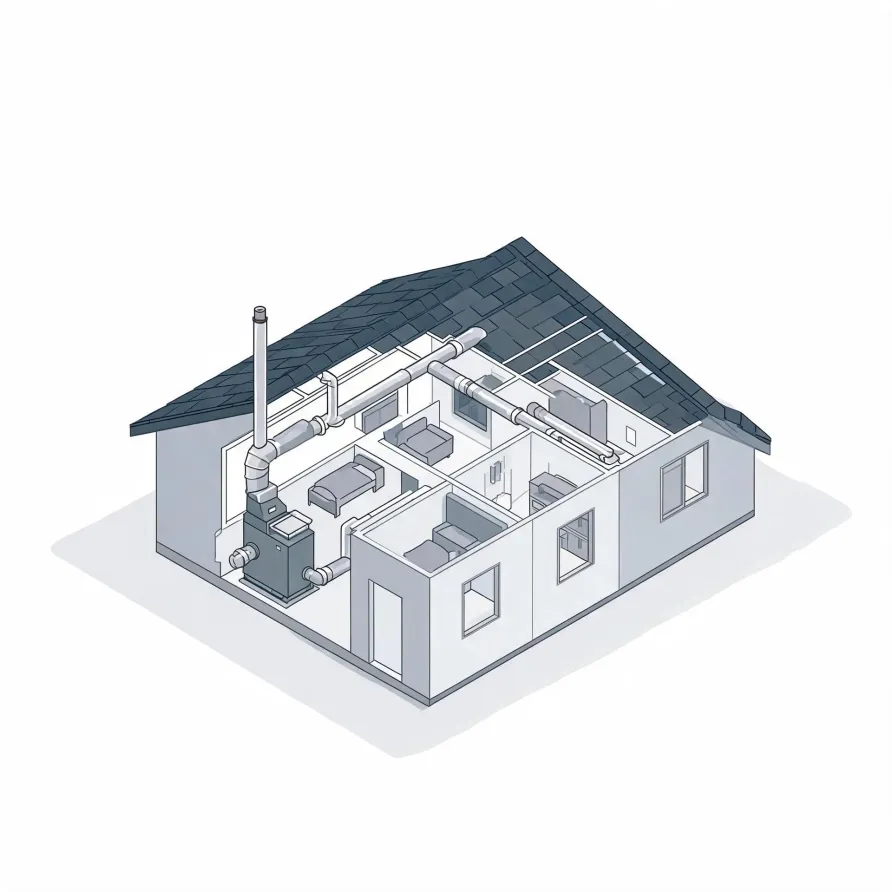
The heat exchanger sits at the core of the furnace cabinet, where it transfers heat to the air moving through the system. When it cracks or corrodes, you may get uneven heat, strange smells, or a furnace that shuts down mid-cycle. The burner assembly feeds directly into it, and a misfiring or dirty burner is one of the first things a contractor looks at.
The blower motor and its fan wheel sit in the lower section of the cabinet and push conditioned air into the supply ducts. The inducer motor pulls combustion gases out through the flue before the burner fires. The control board ties both of those together, and a fault there can mimic failures in almost every other part.
The drawing shows a typical furnace layout, and a licensed contractor determines which components apply to the specific equipment and conditions in your home.
Find a contractor in Laramie CountyLaramie County, by the numbers
2,637 severe weather events were recorded in Laramie County, Wyoming between 2015 and 2024.
NOAA National Centers for Environmental Information, Storm Events Database, bulk CSV export, events 2015-01-01 through 2024-12-31.Half the homes in Laramie County, Wyoming were built in 1980 or earlier (2020-2024 ACS 5-year).
U.S. Census Bureau, 2020-2024 American Community Survey 5-Year EstimatesLaramie County, Wyoming holds 45,659 housing units (2020-2024 ACS 5-year).
U.S. Census Bureau, 2020-2024 American Community Survey 5-Year EstimatesOwners occupy 70.6% of the occupied homes in Laramie County, Wyoming (2020-2024 ACS 5-year).
U.S. Census Bureau, 2020-2024 American Community Survey 5-Year EstimatesFurnace Repair Rules on the Books for Laramie County, Wyoming4 codes, standards, and laws
What the repair visit looks like
Non-weatherized gas furnaces manufactured on or after November 19, 2015 must reach 80.0 percent AFUE.
Non-weatherized oil-fired furnaces manufactured on or after November 19, 2015 must reach 83.0 percent AFUE.
Mobile home gas furnaces manufactured on or after November 19, 2015 must reach 80.0 percent AFUE.
Non-weatherized gas furnaces manufactured on or after December 18, 2028 must reach 95.0 percent AFUE, up from the 80.0 percent minimum that applies to units manufactured before that date.